
Montrose County Court Records After Arrest
A Montrose County jail arrest and a Montrose County court case are linked, but they are not the same record. The Montrose County Sheriff's Office inmate list is a current offense report. It can show a booking number, name number, statute, offense text, court code, offense code, and class. The court record is maintained by the Colorado Judicial Branch in the Montrose Combined District and County Courts. That case file is where formal charges, hearing settings, orders, plea entries, sentence orders, and dispositions are tracked.
The arrest-to-court path is local and practical. Local police or deputies make an arrest, the person is booked at the Montrose County Jail, and the 7th Judicial District Attorney decides what to file. The formal court record may match the jail offense row, or it may not. Charges can be added, reduced, amended, or dismissed after review. Sheriff Gene R. Lillard's office holds the person in jail when custody is local, but the clerk and court maintain the criminal case file.
For custody and booking details, the better starting point is the Montrose County jail inmate records page. For booking photos, use the mugshot and records-request route rather than the court docket. Court records after a jail arrest are mainly about charges, case events, bond, warrants, and final outcomes.
Montrose County Court Record Access
The official Colorado Judicial Branch Montrose County court page identifies the Montrose County Justice Center as the local court hub. The court page lists Montrose Combined District and County Courts, Water Court Division 4, the clerk, the docket link, and local hours. It also notes that the Justice Center complex includes the Sheriff's Administration Building, the Montrose County Jail, and the Montrose County Work Release Center, which is why many arrest, custody, and court tasks occur on the same North Grand Avenue campus.
That shared campus does not merge the records. The Sheriff's Office maintains jail records and some criminal justice records. The clerk maintains court records and routes document requests. The Montrose County public records page also warns that court cases, court dates, jury summons, and divorce or court documents are not county records for the public-records office and must be requested through the Colorado Judicial Branch or the court clerk.
Montrose Combined Courts
1200 North Grand Avenue Bin A
Montrose, CO 81401
970-252-4300
MontroseClerk@judicial.state.co.us, Monday-Friday 7:30 a.m.-4:30 p.m.
7th Judicial District Attorney
1140 N. Grand Ave #200
Montrose, CO 81401
970-252-4260
Find Court Records After Jail Arrest
Begin with the jail record only long enough to collect identifiers. The current MCSO report is not a court search form, and it does not provide document copies. After the arrest, use the court docket and record/document request channels to follow the case. The Judicial Branch public-access guide says online vendor access is limited, and court document copies must come from the individual court or the court records request process.
- Check the current MCSO inmate list if the person is still in jail, then write down the listed name, Booking #, Name Number, statute rows, court code, offense code, and class.
- Open the Montrose County court page and use the "Find Dockets" path for hearing settings tied to the defendant, case number, or location.
- Use the Colorado Judicial Branch record/document request form when a copy of a complaint, information, disposition, sentence order, ticket, protection order, or register of action is needed.
- Search or request by case number when known. If no case number is known, use the defendant name, date of birth, case type, county/location, party information, and approximate filing year.
- Read each charge line separately because one Montrose County arrest can result in several counts with different statuses.
The official Colorado court records access guide is the statewide source for court-document limits. It explains that some information may be online through approved vendors, but copies are not supplied by those commercial access tools. When the task is to prove the filed charge or final disposition, a clerk request is stronger than a roster screenshot.
The court page screenshot from the official Montrose County court page shows the local branch page that routes users to dockets and clerk contact information.
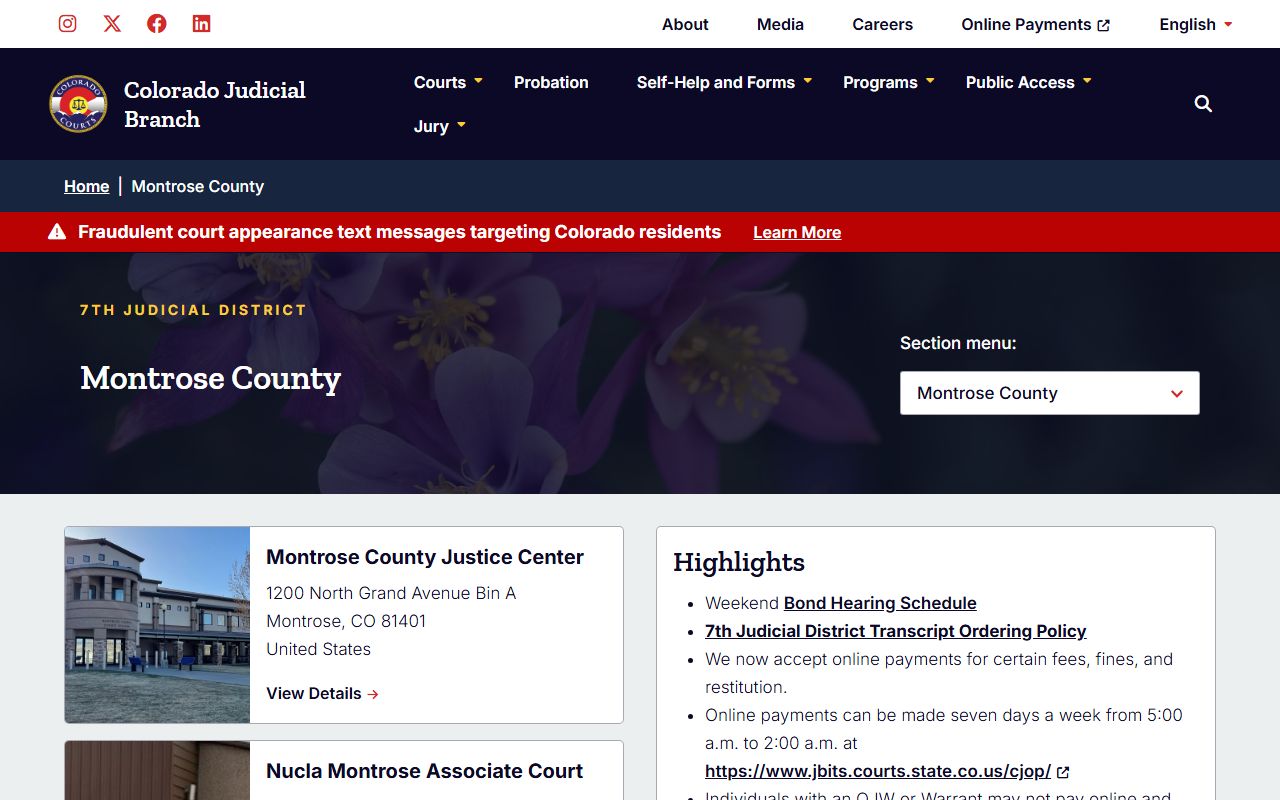
Use the screenshot as a visual cue for the correct court source, then rely on the live court page for current hours, docket links, and clerk routing.
Montrose Court Request Fields
The Colorado Judicial Branch request form is built for document requests rather than jail custody checks. It asks for requester contact information and case-identifying facts. This matters after a Montrose County jail arrest because the jail roster may not show the case number yet. A good request gives the clerk enough detail to find the record without guessing.
| Field or Fee | What to Enter or Expect |
|---|---|
| Requester name and contact | First, middle, last name, email, phone, address, city, state, and ZIP. |
| Case number | Use the court case number if known. The form gives a format example such as 2019T999999. |
| Case type and filing year | Select the case type and approximate year so the request reaches the right court record set. |
| County or location | Select Montrose County unless the form's unknown-county option is truly needed. |
| Party and date of birth | Give the defendant's name, date of birth if known, aliases, and other identifiers from the jail record. |
| Document checkboxes | Criminal request options include Complaint/Information, Disposition/Sentence Order, Protection Order, Ticket, Register of Action, certification, and other documents. |
| Copy and search fees | Research located $0.25 per page, $5 name search, $20 certified or exemplified copy per document, $25 transcript of judgment, $20 certificate of satisfaction, actual off-site retrieval cost, and $30/hour research or redaction after the first hour. |
Fees can change, so confirm the amount on the current Judicial Branch form before paying. For sheriff-held jail records, the county public-records page gives a different local route: the first hour of research is free, and later staff time is $30 per hour paid in advance.
Charging Documents After Arrest
The document that starts or frames the court case is not the same thing as a booking entry. A Montrose County arrest may begin with a police report and jail intake record, but the court case moves on a complaint, information, indictment, ticket, or other filed document. The prosecutor's office is central here. District Attorney Anna Cooling's 7th Judicial District office serves Montrose, Delta, Gunnison, Hinsdale, Ouray, and San Miguel counties, and it files and prosecutes criminal cases rather than running the jail roster.
| Document | Who Files It | Common Use | Why It Matters |
|---|---|---|---|
| Complaint | Officer or prosecutor | Early criminal allegations, often in county or district court processing. | May be the first formal charge document tied to the arrest. |
| Information | Prosecutor | Formal prosecutor-filed charges, including many felony matters. | Shows the counts the DA chose to pursue after review. |
| Indictment | Grand jury | Less common local path, used for serious or grand-jury matters. | Starts the case through grand-jury charging rather than ordinary complaint filing. |
The charging document can narrow or expand what appeared on the jail offense list. Treat the roster as a custody clue, then treat the court filing as the formal charge record.
Montrose Charge Status Records
Charge status is the part of the court record that shows where each count stands. Do not assume the first charge seen after arrest is the final outcome. A charge may be pending while hearings are still open. It may be amended or reduced during plea talks or after legal review. It may be dismissed without a conviction, or it may reach a final disposition through plea, trial, deferred judgment, sentence, or acquittal.
| Status | Plain Meaning | Record Caution |
|---|---|---|
| Pending | The case or count has not reached final disposition. | Do not call it a conviction. |
| Amended | The charge language, count, or cited offense changed. | Compare the current filing to the booking offense row. |
| Reduced | The severity or count was lowered. | The final charge may differ from the arrest allegation. |
| Dismissed | The charge ended without conviction on that count. | Other counts in the same case may still be active. |
| Disposition | The charge or case reached an outcome. | Look for guilty plea, dismissal, deferred judgment, acquittal, or sentence order. |
Bond Records After Arrest
Bond is both a jail issue and a court issue. The MCSO bond page says Montrose County Jail accepts bonds 24 hours a day, seven days a week, including holidays. It accepts cash and surety bonds only. Property bonds are handled through the courts, not at the jail. Public cash and card payments are processed through JailATM, while surety bonds go through a licensed bondsman.
The sheriff's bond instructions also cite Colorado money-bond rights. The page states that bond fees, booking fees, and other debts do not have to be paid to secure release on money bond. It also describes release timing rights after PR bond or cash bond is set and the defendant has returned to jail, unless extraordinary circumstances exist. Bond paperwork should include the next upcoming court date.
| Bond Type | How It Works in Montrose County |
|---|---|
| Cash bond | The full court-set amount is paid. Extremely high cash bonds may use a verifiable cashier's check or money order payable to MCSO. |
| Surety bond | A licensed bonding agent posts through the jail process. Detention staff do not recommend agents. |
| Property bond | Not accepted by Montrose County Jail. It must be requested and handled through court. |
| PR bond | Personal-recognizance release based on the person's promise to appear and comply with conditions. |
| No-bond or hold | Confirm with the court or jail because warrants, detainers, or other agencies can affect release. |
Warrants in Court Records
No official Montrose County Sheriff's Office active-warrant search portal was located in the research. That gap is important. Do not rely on an invented county warrant database. The official court page says people with an OJW or warrant may not pay online and must come to Court. In that context, OJW refers to a court-related payment or appearance issue, not a public warrant search tool.
If a warrant leads to an arrest, the person may be booked into Montrose County Jail and may appear on the current inmate list while held. If the person is not listed, they may have been released, transferred, held elsewhere, not booked into the county jail, or not visible on the current public roster. For a court warrant, use the Montrose clerk. For a sheriff-held record, use the MCSO records channel. For parole or state-prison status, use CDOC.
- Bench warrant
- A judge-issued warrant, often for failure to appear or failure to comply.
- Arrest warrant
- A court order authorizing law enforcement to arrest a named person.
- Detainer
- A hold or request from another agency that can delay release after local bond is posted.
- Mittimus
- A court order directing a person to serve a sentence or be taken to custody.
Charges vs Convictions
A charge is an allegation. A conviction is a court judgment of guilt after a plea or verdict. That distinction is essential when reading Montrose County court records after a jail arrest. The roster may list offense rows at booking, but those rows do not prove guilt and do not show the final court result.
| Point of Comparison | Charge | Conviction |
|---|---|---|
| Stage | Filed allegation or count in the case. | Final judgment of guilt by plea or verdict. |
| Proof level | Based on arrest facts, probable cause, and prosecutor filing decisions. | Requires plea, verdict, or other legally sufficient outcome. |
| Can change | Yes. It may be amended, reduced, added, or dismissed. | Can be appealed or affected by later court orders, but it is no longer just an accusation. |
| Where to verify | Charging document, docket, and clerk record. | Disposition, judgment, sentence order, and clerk record. |
Sealed and Expunged Records
Colorado uses sealing for many adult criminal justice record situations. A sealed record is restricted from ordinary public access, but courts, law enforcement, prosecutors, and some authorized background-check users may still have access under state law. The Colorado Judicial Branch sealing page provides JDF packets for arrest, non-conviction, conviction, municipal, multiple-case, and juvenile categories. Adult expungement is narrower and is often discussed most clearly in juvenile contexts.
| Point of Comparison | Sealed | Expunged |
|---|---|---|
| Public visibility | Restricted from ordinary public access after a court order. | Treated more like removal from ordinary record access when the law allows it. |
| Common Colorado use | Adult arrest, non-conviction, eligible conviction, and related criminal justice records. | More limited, often tied to juvenile matters or specific statutory categories. |
| Agency access | Courts, law enforcement, prosecutors, and specified users may still access sealed records. | Access is narrower, but do not assume every trace is destroyed without reviewing the order. |
| Starting point | Colorado Judicial Branch sealing instructions and the correct JDF packet. | Colorado Judicial Branch juvenile or specific expungement instructions if eligible. |
C.R.S. 24-72-703 and related sections provide Colorado's sealing framework. C.R.S. 24-72-303 keeps records of official action open unless another law limits access, and C.R.S. 24-72-305 gives criminal justice records custodians discretion when disclosure is barred by law, court rule, court order, or public-interest limits.
When Sheriff Records Fit
Some arrest-related records are not court records. The MCSO records page says sheriff criminal justice records may include case reports, jail records, and 911 recordings. The online Montrose County Sheriff's records request form and the MCSO Records Check Request PDF are the local channels for sheriff-held records. The PDF includes Background, Mug Shot, and Report request options and includes a no-solicitation certification tied to Colorado criminal justice records law.
Use sheriff records when the issue is booking, jail custody, a sheriff report, 911 audio, or a mugshot request. Use court records when the issue is the filed criminal case, docket, charging document, disposition, sentence order, or protection order. Use CDOC for sentenced Colorado prison custody, the Federal Bureau of Prisons locator for federal sentenced custody, and ICE ODLS for immigration detention. A single Montrose County arrest can move through more than one of those systems.
Important: Court, jail, and background-check records are separate, and casual lookup results are not approved for FCRA-covered screening decisions.
Public Record Search
Sponsored Results